
We Have Turned “Professionalism” Into a Polite Way of Saying “Don’t Speak”
The workplace loves the language of openness, but often rewards something very different: employees who know when to stay quiet, when to smile and when not to make leadership uncomfortable.
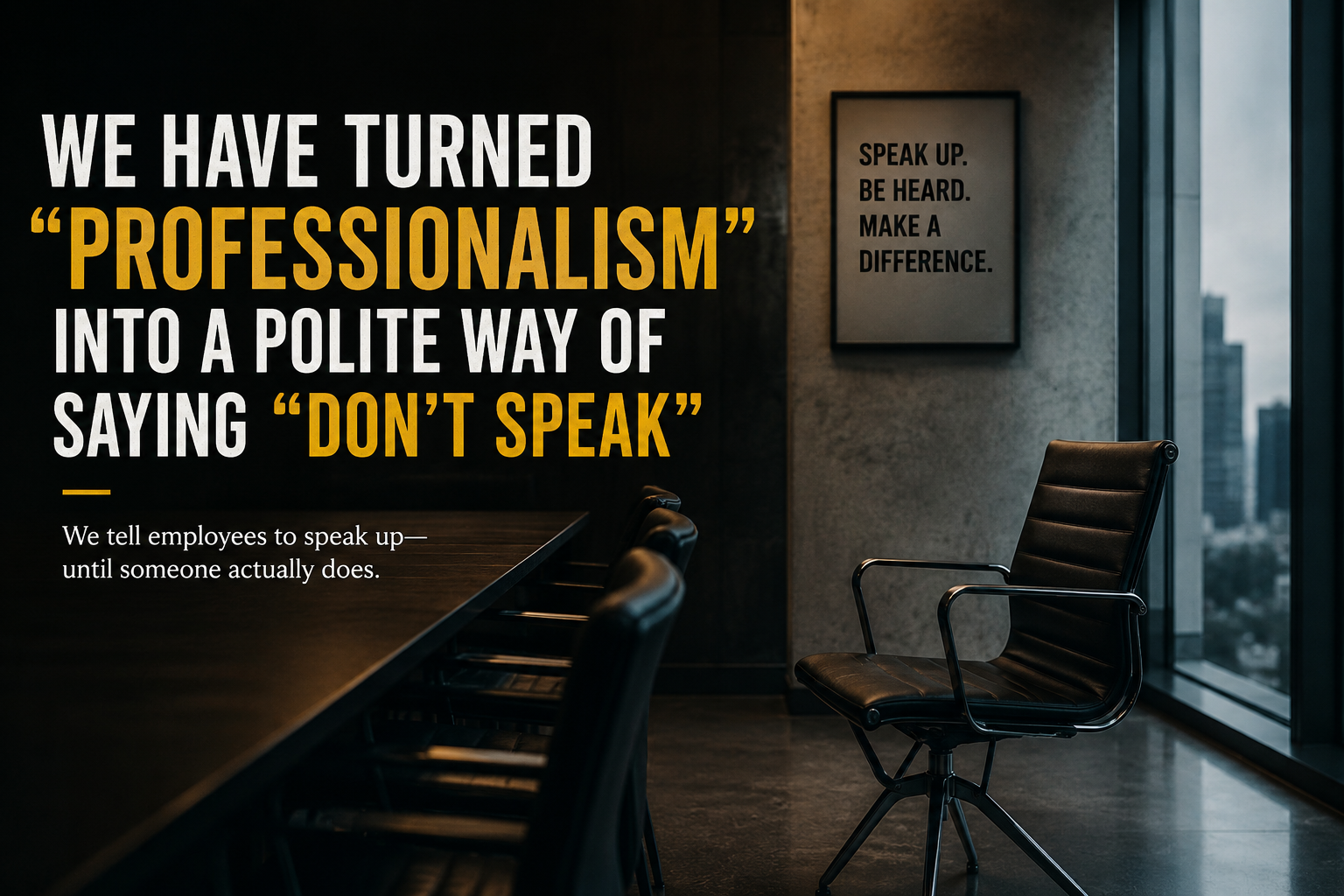
The Workplace Says It Wants Honesty
Every workplace has the same language now. Your voice matters. Speak up. We value feedback. My door is always open. Tell us what you think.
Fine. But here is the question nobody likes asking: what happens when someone actually does it?
Because it is easy to say you want honest employees. It is much harder to deal with an employee who tells you that your decision was bad, your process is broken, or your manager is the problem.
That is where the nice language usually ends.
Professionalism Has Become a Convenient Excuse
Let us be clear. People should be respectful at work. Being rude is not the same as being brave. Personal attacks are not feedback.
But sometimes the word professionalism is used for something else. It becomes a polite way of telling someone to sit down, smile and stop making people uncomfortable.
Question a senior person too directly and suddenly your tone is the issue. Challenge a decision and you are difficult. Refuse to keep quiet about something you think is wrong and you may be accused of having an attitude.
Notice what happens next. The original issue disappears. Everyone starts discussing the employee instead.
Power Changes the Rules
This is the part people do not like admitting. The same behaviour is often judged differently depending on who does it.
People Are Not Silent Because They Have Nothing to Say
Sometimes people are quiet because they have learned the cost of speaking.
They watch what happens to the colleague who raised a concern. They notice who gets labelled difficult. They see which complaints are taken seriously and which ones quietly disappear. They learn whether anonymous really means anonymous.
Then they adjust.
They stop raising their hand. They stop asking questions. They stop volunteering uncomfortable information.
And the organisation looks around and says, “Good. Things seem calm.”
The Quiet Workplace Is Not Necessarily a Healthy Workplace
No complaints does not automatically mean no problems.
Sometimes it means people are tired. Sometimes they are afraid. Sometimes they have tried before and nothing changed.
The most dangerous culture is not always the loud one. It can be the one where everyone has learned to keep their head down.
So What Should We Actually Want?
We should want employees who can say things that are uncomfortable without being treated like enemies.
And leaders need to hear those words without immediately taking them personally.
That does not mean every complaint is correct. It means every serious concern deserves to be examined before the person raising it is examined.
Maybe We Need to Stop Lying to Ourselves
If you only want employees to speak when they agree with you, say that.
If you only want feedback that is comfortable, say that too.
But do not put “Speak Up” on a poster and then punish people socially or professionally when they take you seriously.
You cannot demand honesty and then become offended by the honest answer.
You cannot tell people that their voice matters and then only listen when their voice agrees with yours.
That is not a speaking-up culture. That is a performance.
If the only thing people remember about your complaint is your tone, maybe they were never interested in the complaint.
A senior leader is blunt. We call it decisiveness.
A junior employee is blunt. We call it disrespect.
A manager challenges a process. We call it leadership.
An employee challenges the same process. We call it insubordination.
Silence is not always agreement. Sometimes it is an employee deciding that honesty is no longer worth the trouble.
The real test of a speaking-up culture is not whether people are invited to talk. It is what happens to them after they do.